Faithful Multimodal Intelligence and World Modeling
I build multimodal models that learn physical laws and world dynamics from large-scale unlabeled video, grounding decisions in
perceptual evidence rather than language priors.
Scalable Multimodal Action Reasoning and Agents
I study controllable systems that integrate images, video, audio, and actions, aiming for practical agentic tools for creative
workflows like filmmaking and design.
I am always open to research collaborations. Students interested in a research internship with me are also very welcome —
feel free to reach out by email anytime!
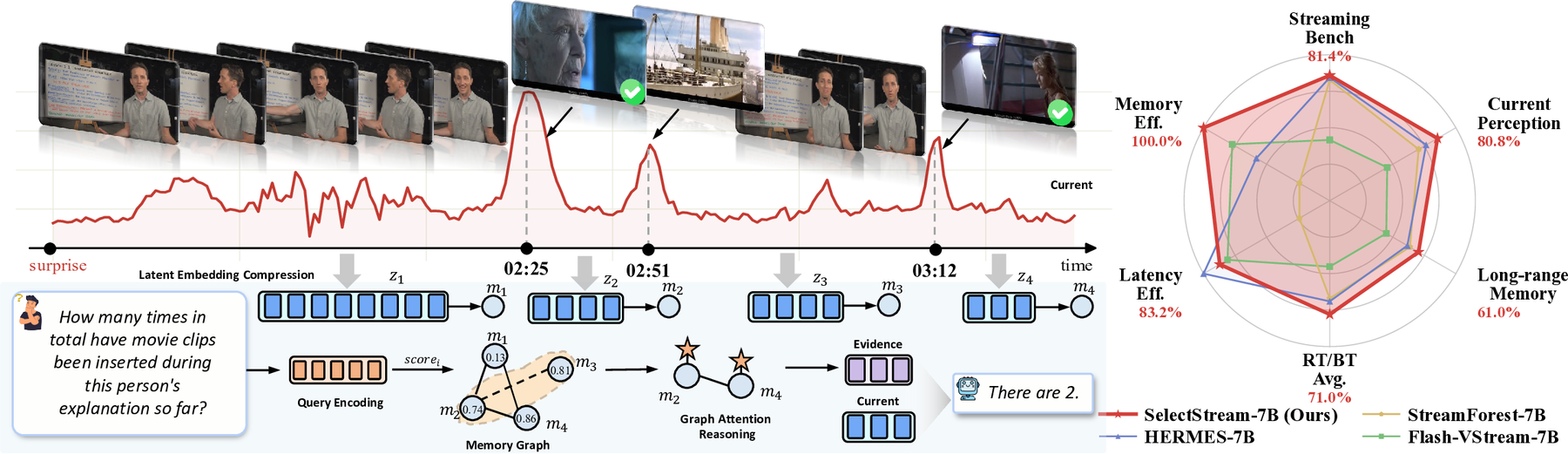
Streaming video understanding models must answer queries at any moment during an ongoing stream, using only what they have observed so far and under fixed memory and computation budgets. Existing methods address this by adding memory banks, retrieval modules, or visual token compression to preserve long-range history. However, strong recent-window baselines show that indiscriminate history injection can dilute current-scene perception, suggesting that the key challenge is not whether to use memory, but how to allocate it selectively. We formulate this as budgeted online latent evidence allocation and propose SelectStream, a selective latent-memory framework that keeps the current observation directly visible to a frozen VLM while exposing historical information only through a compact, query-conditioned evidence budget. Three coordinated mechanisms govern when to write, what to preserve, and how to retrieve: surprise-driven adaptive windowing, priority-preserving consolidation, and query-conditioned graph reasoning over a fixed-capacity latent memory graph. Retrieved evidence is calibrated and injected as latent tokens for answer generation, without replaying frames or growing the context with stream length. Experimental results show that SelectStream achieves strong online streaming performance and preserves general video understanding, reaching 82.67% on StreamingBench, 67.03% on OVO-Bench, and 74.4% average accuracy on offline video benchmarks, while outperforming strong recent-window baselines and prior streaming memory methods.
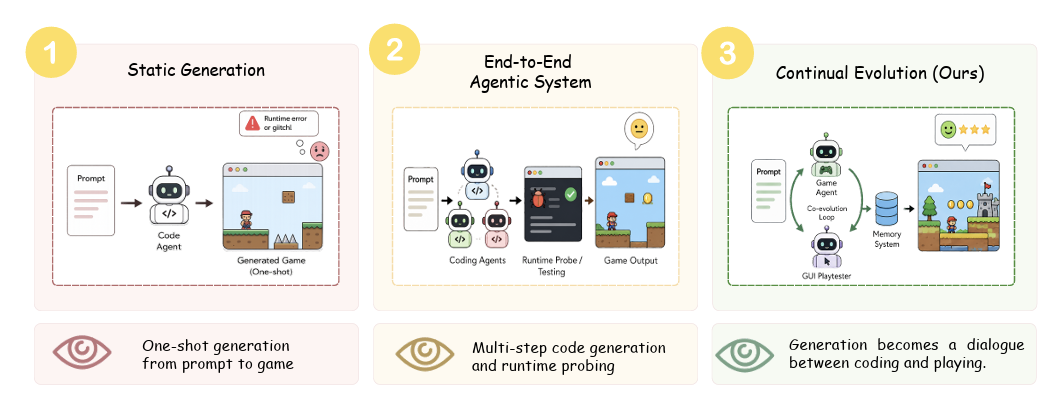
Generating a game is not the same as making one that can be played. Despite advances in code generation, existing approaches treat game generation as one-shot translation from prompt to artifact, leaving interaction-level failures undetected. We argue that evaluating and improving game generation requires a player, and study two roles for graphical user interface (GUI) agents in this process: (1) as an objective evaluator, for which we introduce PlaytestArena, a new evaluation environment that pairs 200 browser-based game generation tasks across eight genres with rubrics of expected in-play behaviors, adjudicated by a GUI agent that loads each build in a browser and plays it; and (2) as a subjective playtester, for which we propose Play2Code, where a game agent and a GUI agent operate in a sustained loop with shared memory, turning game generation into a dialogue between coding and playing. Our experiments show that even frontier models struggle to generate playable games directly, while Play2Code achieves a 66.8% rubric pass-rate, improving over single-pass and agentic-coding baselines by 37.1 and 14.6 points respectively. Further analysis shows that GUI playtester feedback is more traceable than a human report, yet idiosyncratic in ways reminiscent of human testers, establishing game playtesting as a critical testbed for interactive code generation.
NeurIPS
CamReasoner: Reinforcing Camera Movement Understanding via Structured Spatial Reasoning
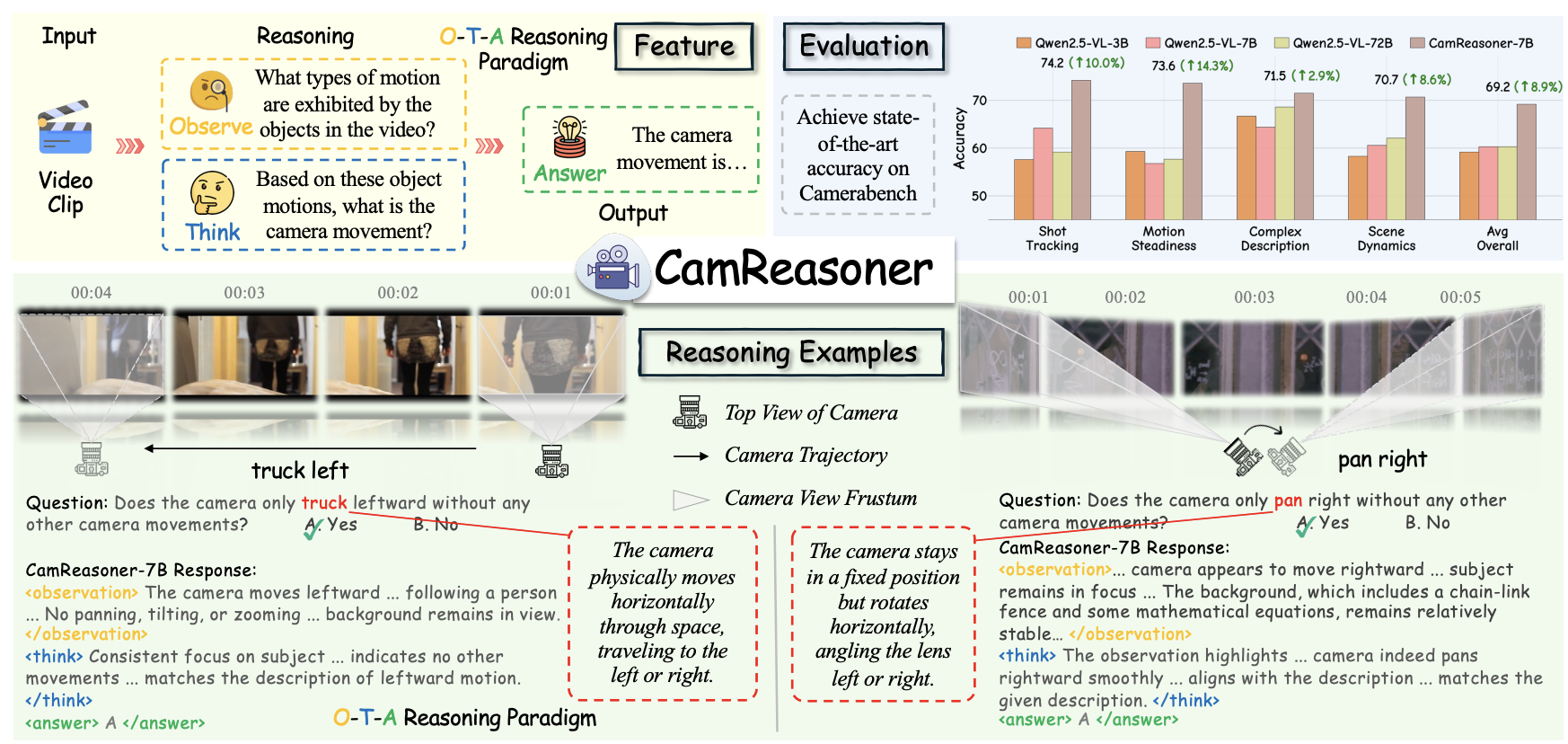
Understanding camera dynamics is a fundamental pillar of video spatial intelligence. However, existing multimodal models predominantly treat this task as a black-box classification, often confusing physically distinct motions by relying on superficial visual patterns rather than geometric cues. We present CamReasoner, a framework that reformulates camera movement understanding as a structured inference process to bridge the gap between perception and cinematic logic. Our approach centers on the Observation-Thinking-Answer (O-T-A) paradigm, which compels the model to decode spatio-temporal cues such as trajectories and view frustums within an explicit reasoning block. To instill this capability, we construct a Large-scale Inference Trajectory Suite comprising 18k SFT reasoning chains and 38k RL feedback samples. Notably, we are the first to employ RL for logical alignment in this domain, ensuring motion inferences are grounded in physical geometry rather than contextual guesswork. By applying Reinforcement Learning to the Observation-Think-Answer (O-T-A) reasoning paradigm, CamReasoner effectively suppresses hallucinations and achieves state-of-the-art performance across multiple benchmarks.
NeurIPS
FrameMind: Frame-Interleaved Video Reasoning via Reinforcement Learning
Haonan
Ge, Yiwei
Wang, Kai-Wei
Chang, and
2 more authors
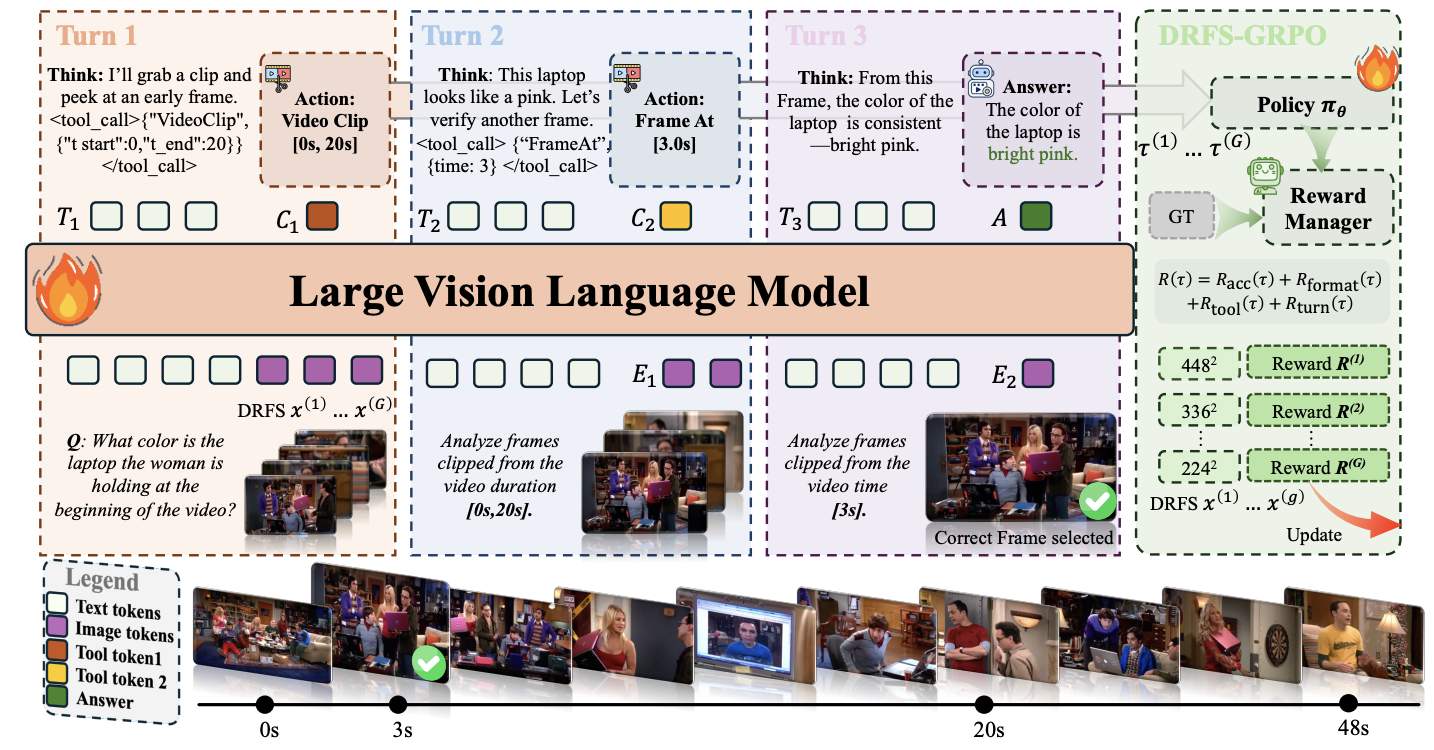
Current video understanding models rely on fixed frame sampling strategies, processing predetermined visual inputs regardless of the specific reasoning requirements of each question. This static approach limits their ability to adaptively gather visual evidence, leading to suboptimal performance on tasks that require either broad temporal coverage or fine-grained spatial detail. In this paper, we introduce FrameMind, an end-to-end framework trained with reinforcement learning that enables models to dynamically request visual information during reasoning through Frame-Interleaved Chain-of-Thought (FiCOT). Unlike traditional approaches, FrameMind operates in multiple turns where the model alternates between textual reasoning and active visual perception, using tools to extract targeted frames or video clips based on identified knowledge gaps. To train effective dynamic sampling policies, we propose Dynamic Resolution Frame Sampling (DRFS), which exposes models to diverse temporal-spatial trade-offs during learning, and DRFS-GRPO, a group-relative policy optimization algorithm that learns from outcome-based rewards without requiring frame-level annotations. Extensive experiments on challenging benchmarks like MLVU and VideoMME demonstrate that our method significantly outperforms existing models, advancing the state of the art in flexible and efficient video understanding.
ICLR
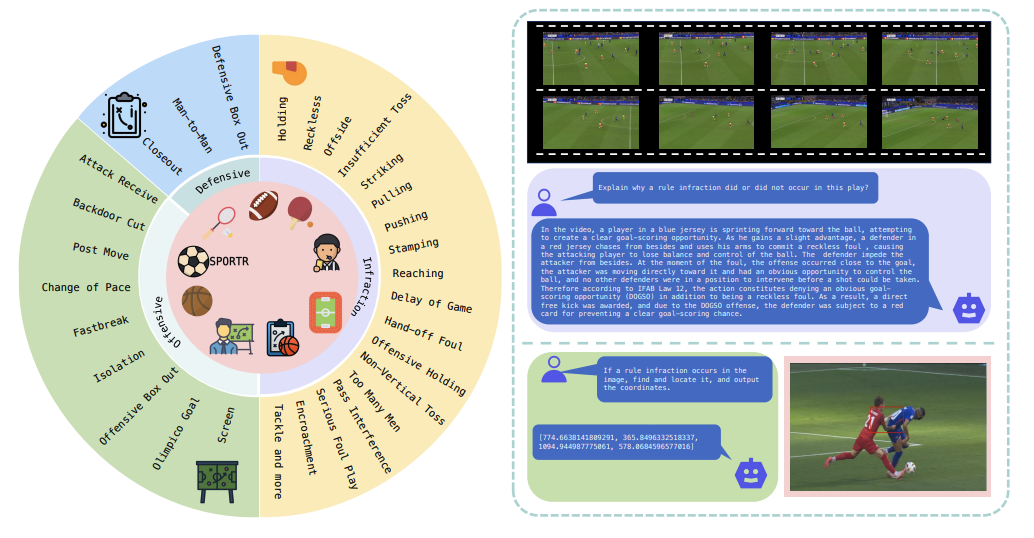
SportR: A Benchmark for Multimodal Large Language Model Reasoning in Sports
Haotian
Xia*, Haonan
Ge*, Junbo
Zou*, and
16 more authors
Artificial Intelligence brings powerful new tools to sports, from automated officiating to tactical analysis, but these applications all depend on a core reasoning capability. Deeply understanding sports requires an intricate blend of fine-grained visual perception and rule-based reasoning—a challenge that pushes the limits of current multimodal models. To succeed, models must master three critical capabilities: perceiving nuanced visual details, applying abstract sport rule knowledge, and grounding that knowledge in specific visual evidence. Current sports benchmarks either cover single sports or lack the detailed reasoning chains and precise visual grounding needed to robustly evaluate these core capabilities in a multi-sport context. To address this gap, we introduce SportR, the first multi-sports large-scale benchmark designed to train and evaluate MLLMs on the fundamental reasoning required for sports intelligence. Our benchmark provides a dataset of 5,017 images and 2,101 videos. To enable granular evaluation, we structure our benchmark around a progressive hierarchy of question-answer (QA) pairs designed to probe reasoning at increasing depths—from simple infraction identification to complex penalty prediction. For the most advanced tasks requiring multi-step reasoning, such as determining penalties or explaining tactics, we provide 7,118 high-quality, human-authored Chain-of-Thought (CoT) annotations. In addition, our benchmark incorporates both image and video modalities and provides manual bounding box annotations to directly test visual grounding in the image part. Extensive experiments demonstrate the profound difficulty of our benchmark. State-of-the-art baseline models perform poorly on our most challenging tasks. While training on our data via Supervised Fine-Tuning and Reinforcement Learning improves these scores, they remain relatively low, highlighting a significant gap in current model capabilities. SportR presents a new challenge for the community, providing a critical resource to drive future research in multimodal sports reasoning.
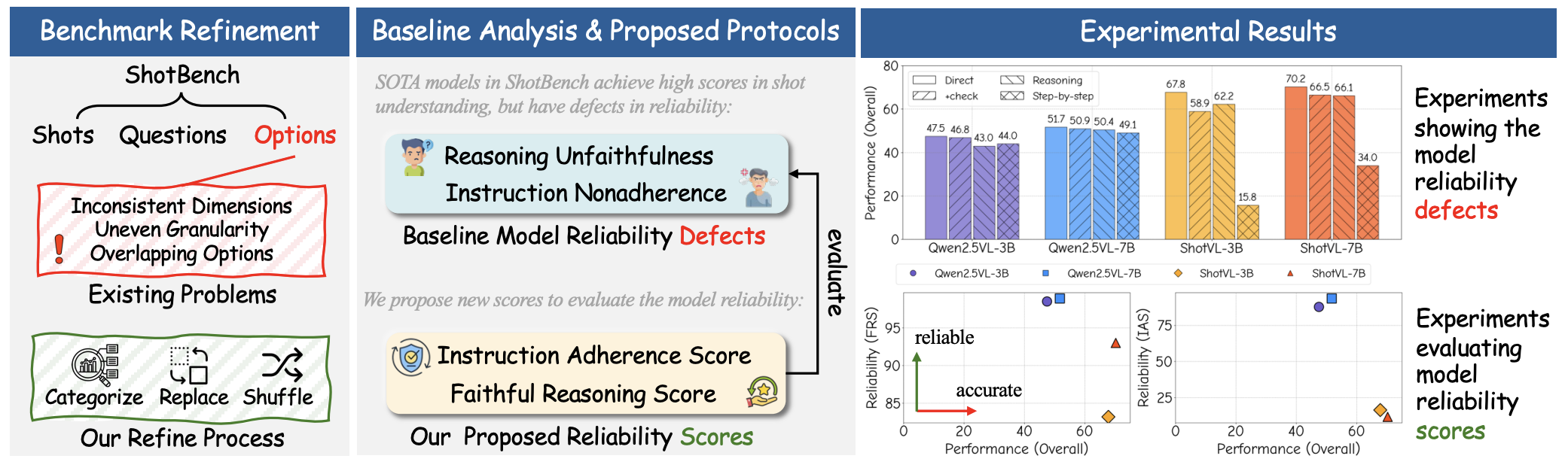
RefineShot: Rethinking Cinematography Understanding with Foundational Skill Evaluation
Cinematography understanding refers to the ability to recognize not only the visual content of a scene but also the cinematic techniques that shape narrative meaning. This capability is attracting increasing attention, as it enhances multimodal understanding in real-world applications and underpins coherent content creation in film and media. As the most comprehensive benchmark for this task, ShotBench spans a wide range of cinematic concepts and VQA-style evaluations, with ShotVL achieving state-of-the-art results on it. However, our analysis reveals that ambiguous option design in ShotBench and ShotVL’s shortcomings in reasoning consistency and instruction adherence undermine evaluation reliability, limiting fair comparison and hindering future progress. To overcome these issues, we systematically refine ShotBench through consistent option restructuring, conduct the first critical analysis of ShotVL’s reasoning behavior, and introduce an extended evaluation protocol that jointly assesses task accuracy and core model competencies. These efforts lead to RefineShot, a refined and expanded benchmark that enables more reliable assessment and fosters future advances in cinematography understanding.
EMNLP
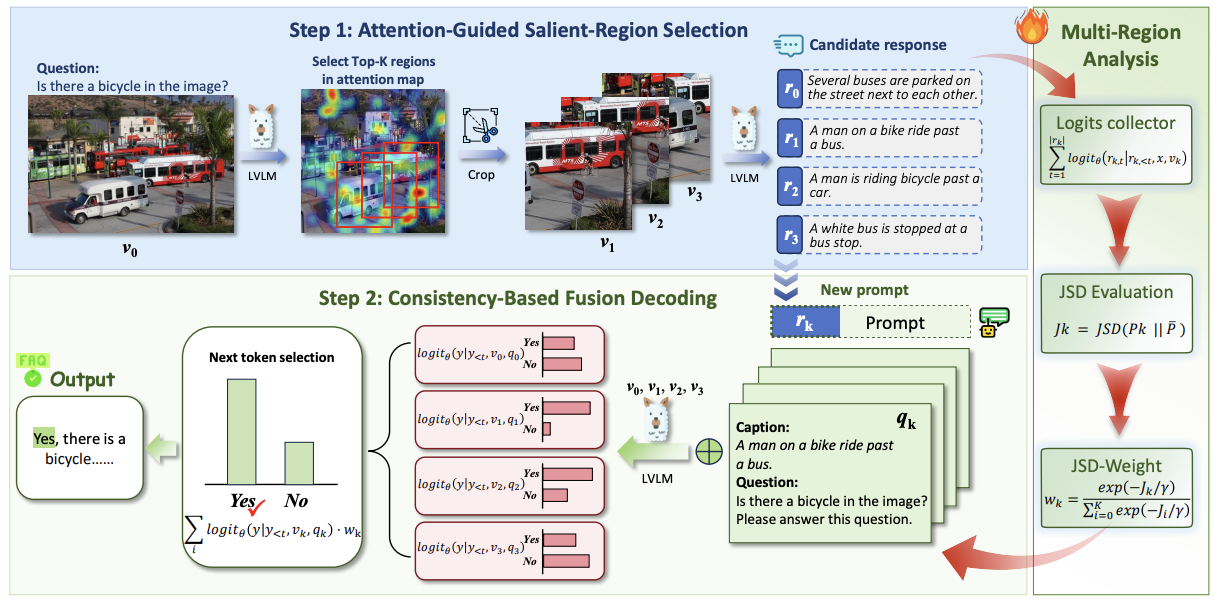
MRFD: Multi-Region Fusion Decoding with Self-Consistency for Mitigating Hallucinations in LVLMs
Haonan
Ge, Yiwei
Wang, Ming-Hsuan
Yang, and
1 more author
Large Vision-Language Models (LVLMs) have shown strong performance across multimodal tasks. However, they often produce hallucinations – text that is inconsistent with visual input, due to the limited ability to verify information in different regions of the image. To address this, we propose Multi-Region Fusion Decoding (MRFD), a training-free decoding method that improves factual grounding by modeling inter-region consistency. MRFD identifies salient regions using cross-attention, generates initial responses for each, and computes reliability weights based on Jensen-Shannon Divergence (JSD) among the responses. These weights guide a consistency-aware fusion of per-region predictions, using region-aware prompts inspired by Chain-of-Thought reasoning. Experiments across multiple LVLMs and benchmarks show that MRFD significantly reduces hallucinations and improves response factuality without requiring model updates.
* denotes equal contribution
Academic Services
Conference Reviewer:
ICLR 2027WACV 2027NeurIPS 2026ACM MM 2026CVPR 2026WACV 2026
Co-led a vision-language sports benchmark and reinforcement learning project with
Prof. Hanjie Chen.
Miscellaneous
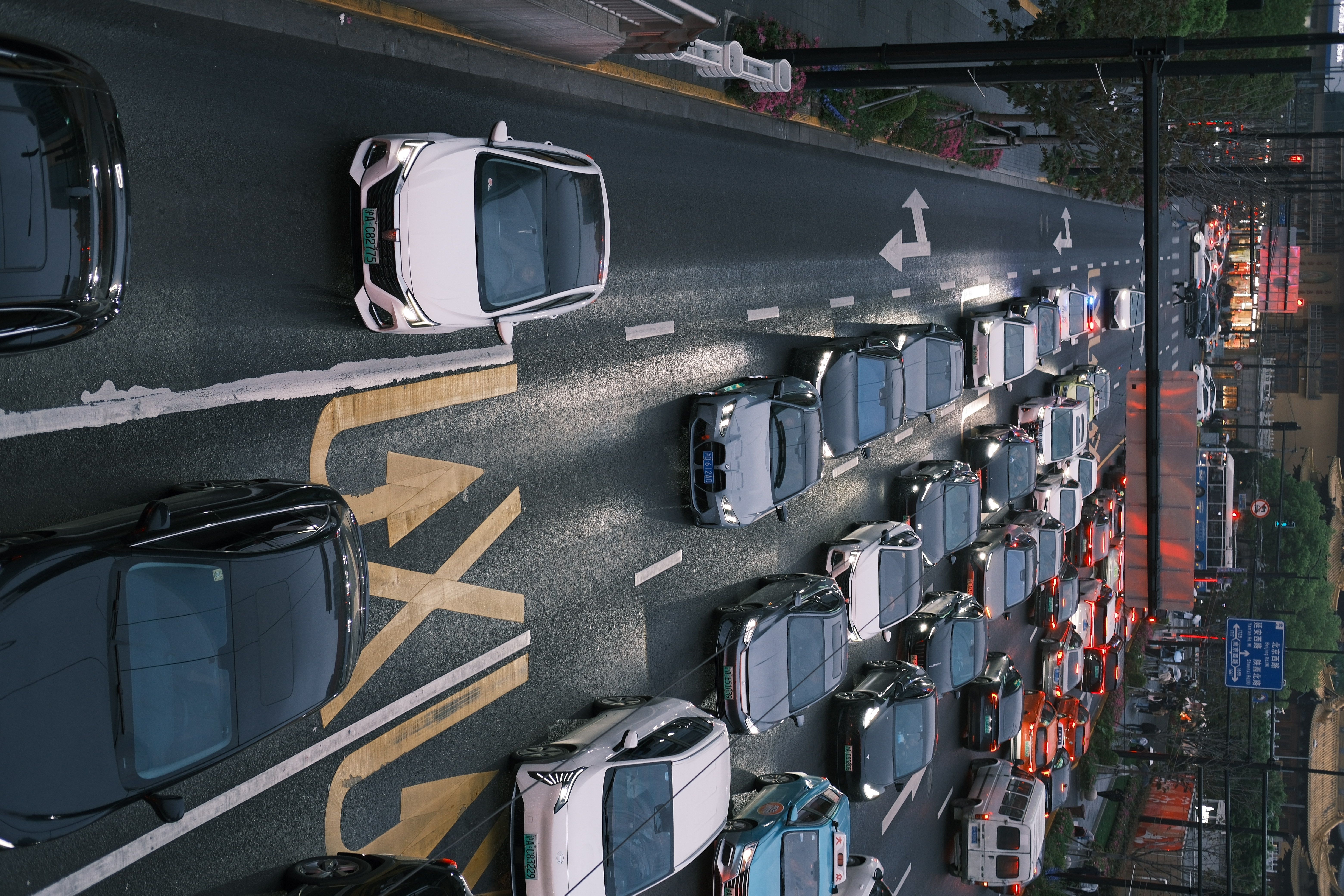
Beyond my academic pursuits, I lead a vibrant life filled with diverse interests. I am passionate about photography, capturing city nights, landscapes, and skies through both digital and film lenses. Music is an indispensable part of my daily routine—I am a huge fan of Jay Chou and absolutely love singing to unwind. To recharge, I enjoy cycling to explore the city and immersing myself in fascinating virtual worlds through gaming. Above all, I am a devoted cat lover, and spending quiet moments with my feline friends always brings me immense joy.

 ,
advised by Prof. Yao Qin. I received my bachelor's degree in Electrical
and Computer Engineering from Southeast University
,
advised by Prof. Yao Qin. I received my bachelor's degree in Electrical
and Computer Engineering from Southeast University .
.
 and
The University of Queensland
and
The University of Queensland , advised by
Prof. Yujun Cai (UQ) and
Prof. Yiwei Wang (UC Merced), and I continue to collaborate with them as well as
Prof. Kai-Wei Chang (UCLA)
, advised by
Prof. Yujun Cai (UQ) and
Prof. Yiwei Wang (UC Merced), and I continue to collaborate with them as well as
Prof. Kai-Wei Chang (UCLA) and
Prof. Ming-Hsuan Yang (UC Merced)
and
Prof. Ming-Hsuan Yang (UC Merced)